

Gutenberg's invention
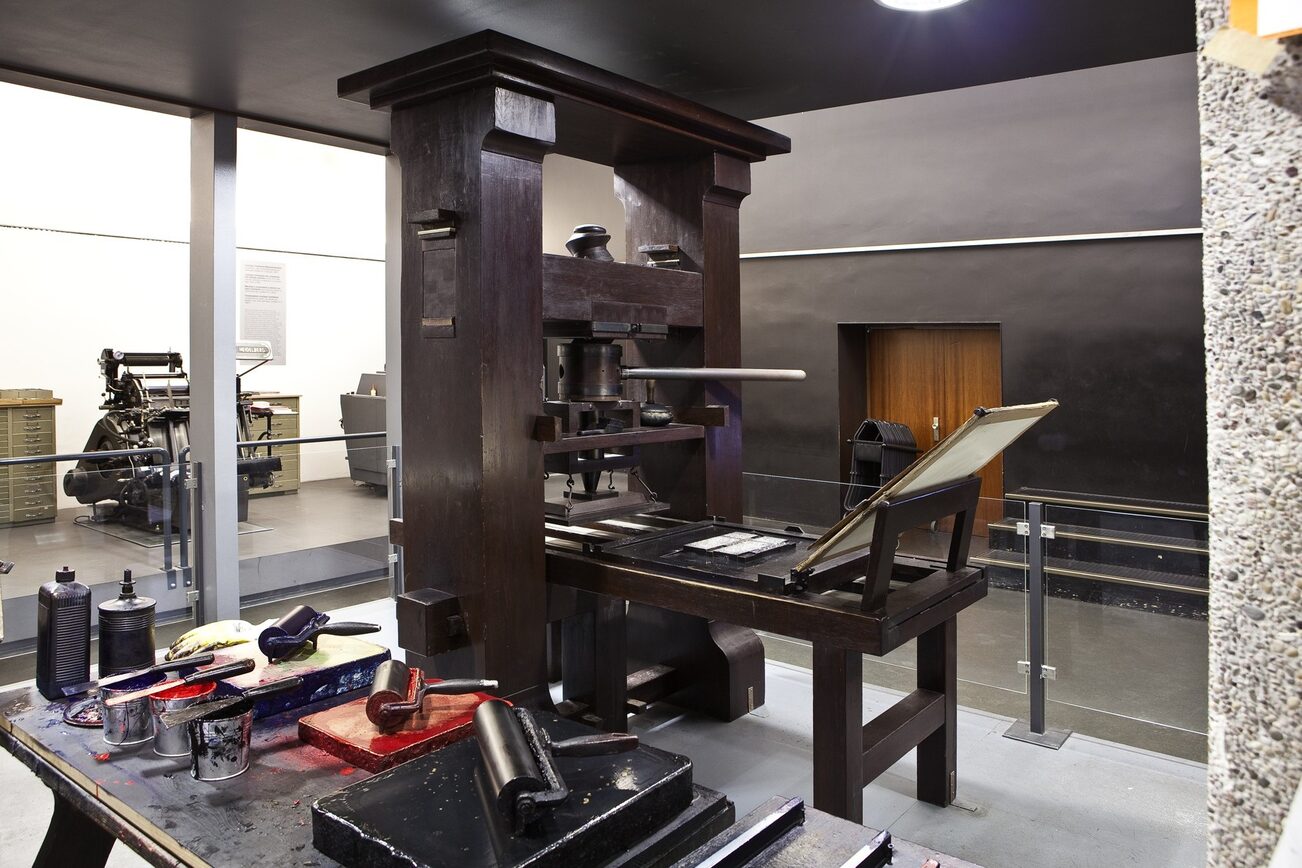
Printing was already being done before Gutenberg using woodblock printing. This involved placing paper on a carved and inked wooden block and rubbing it—a laborious and time-consuming process.
The basic idea behind Gutenberg's invention was to break down the text into all its individual elements, such as lowercase and uppercase letters, punctuation marks, ligatures, and abbreviations, as was common practice in the tradition of medieval scribes. These individual elements were cast as mirror-image letters in any number, and finally assembled into words, lines, and pages. The original form or prototype for each letter was the stamp.
The character was cut into the front of a steel pin, resulting in a precise, mirror-image relief. The respective stamp, the patrix, was then "struck" into a rectangular block of softer metal, usually copper, i.e., indented vertically with a hammer blow. The matrix thus produced had to be reworked and straightened to create a right-angled cube with straight sides. The image, which was the correct way round, had to have a uniform depth, which is why the surface was worked with a file.
To cast a letter, Gutenberg developed the hand casting instrument. Two parts enclose a rectangular casting channel, one end of which was closed by inserting the matrix. After casting the letters in the hand casting instrument, the sprue had to be removed.

Each letter had a "predetermined breaking point" so that all letters automatically had the same height. The hand casting instrument, the most important part of the invention, made it possible to quickly cast the required quantities of a wide variety of letters. The cast metal was an alloy of lead, tin, and other additives, which ensured rapid cooling and sufficient durability under the high pressure of the press.
The printing press, which greatly accelerated the printing process compared to the rubbing press known until then, was a spindle press with special equipment for the effective and even transfer of the print image from the mold to the paper or parchment.